


 Call Mon–Fri 8:00 AM–6:30 PM · Sat 9:00 AM–2:00 PM





If you’ve lived in Ohio for even a year, you already know the weather doesn’t sit still for long. One week, you’re dealing with heavy rain; the next, it’s freezing temperatures, and somewhere in between, strong winds decide to join the mix.
Now here’s something most homeowners don’t think about right away: your fence installation deals with all of that, every single day.
A fence isn’t just about looks or marking property lines. It’s an outdoor structure that has to handle moisture, heat, cold, and movement in the ground. Pick the wrong material, and you’ll feel it within a season or two. Warping, leaning, fading, even early repairs… it adds up fast.
So before choosing a fence style, it helps to understand how Ohio’s weather quietly shapes what works and what doesn’t.
Ohio Weather Isn’t Gentle on Outdoor Structures
Let’s paint a quick picture of what your fence is up against throughout the year.
- Cold winters with freezing and thawing cycles
- Wet springs with heavy rainfall and saturated soil
- Hot, humid summers that stress materials
- Windy days and storms that test structural strength
Each of these conditions affects fences differently. And the tricky part? It’s not just one factor. It’s the constant switching between them.
For example, freezing temperatures cause the ground to expand. When it warms up, the soil contracts again. That back-and-forth movement can slowly shift fence posts out of alignment.
At the same time, moisture from rain and humidity can seep into certain materials, weakening them over time.
So the real question becomes: which materials can handle this cycle without constant headaches?
Why Moisture Is One of the Biggest Problems
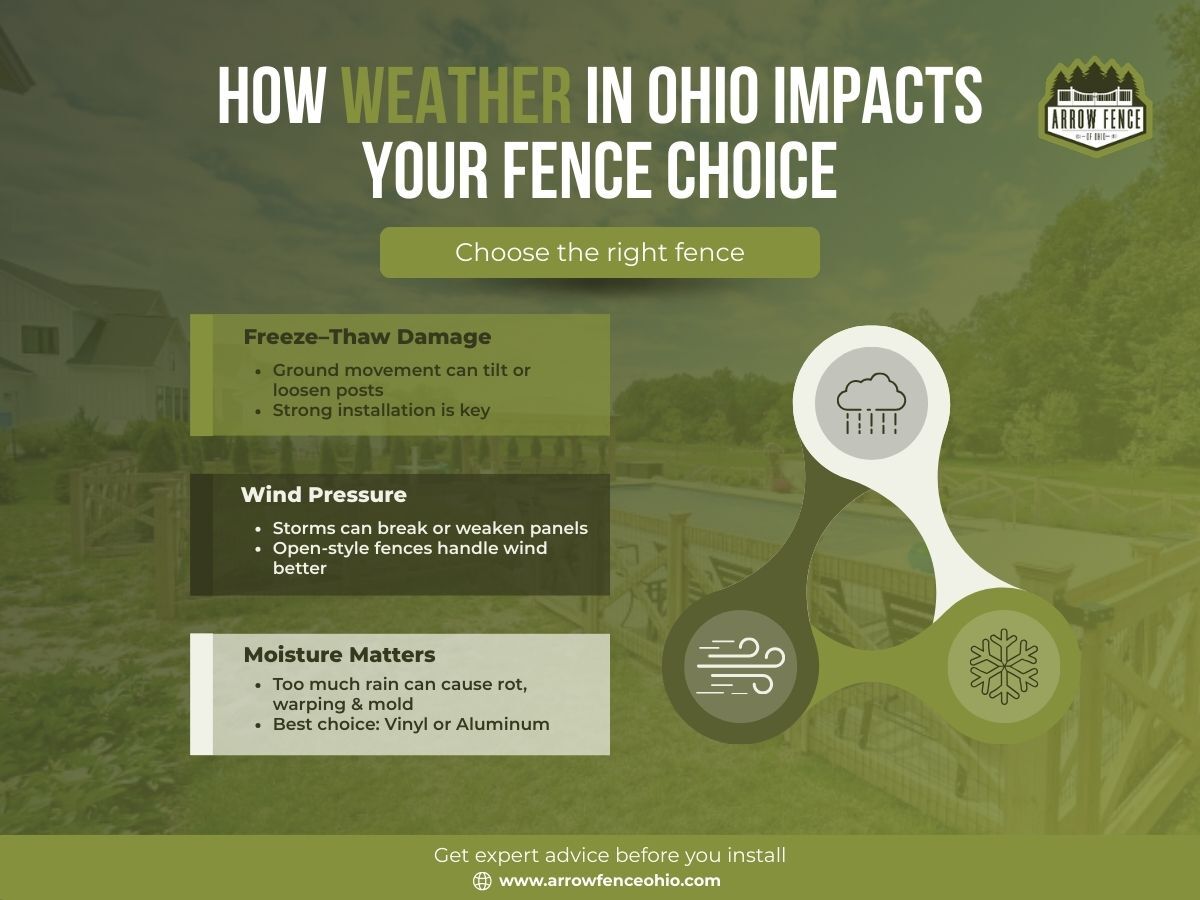
If there’s one thing Ohio has plenty of, it’s moisture. Rain, snow, humidity… It all adds up.
Wood fences tend to feel this the most. When wood absorbs water, it expands. When it dries, it shrinks. Over time, that movement can lead to:
- Cracks and splitting
- Warping boards
- Loose fasteners
- Mold or mildew growth
And once moisture gets deep into the structure, repairs become more frequent.
Vinyl and aluminum fences, on the other hand, don’t absorb water in the same way. That gives them a big advantage in wet conditions. They stay more stable and don’t change shape as much.
Still, even moisture-resistant materials need proper installation. Poor drainage around posts can cause shifting, no matter what the fence is made of.
Freeze and Thaw Cycles: The Silent Fence Killer
This is one of those things people don’t notice until it’s too late.
During winter, water in the soil freezes and expands. When it melts, the ground softens and shifts. This cycle repeats over and over, especially in Ohio.
What does that mean for your fence?
Posts can slowly move upward or tilt. Even a small shift can throw off alignment across the entire fence line.
Wood and chain-link fences are often more affected because they rely heavily on post stability. If the base isn’t set deep enough or secured properly, movement becomes noticeable pretty quickly.
A well-installed fence accounts for this by setting posts below the frost line and using proper concrete support. It’s not flashy work, but it makes all the difference over time.
Summer Heat and UV Exposure
Cold weather gets a lot of attention, but summer brings its own challenges.
Direct sunlight and heat can
- Fade colors
- Dry out wood
- Cause expansion in certain materials
- Make surfaces brittle over time
Wood fences may start to lose their finish or become rough unless they’re sealed or stained regularly.
Vinyl fences hold their color better, but lower-quality options can become slightly brittle after long exposure to heat and UV rays.
Aluminum tends to handle sunlight well, especially when it has a protective coating.
So if your yard gets a lot of direct sun, this is something worth thinking about before making a choice.
Wind and Storm Resistance Matters More Than You Think
Ohio storms can be unpredictable. Strong winds don’t just shake trees; they can push hard against fence panels.
Solid privacy fences, especially tall ones, act like a wall against the wind. That pressure can lead to:
- Loose posts
- Broken panels
- Entire sections are leaning or falling
Open-style fences like aluminum or chain link allow wind to pass through more easily. That reduces pressure and makes them less likely to suffer storm damage.
That doesn’t mean privacy fences are a bad choice. It just means they need stronger support, better spacing, and solid installation.
Comparing Fence Materials for Ohio Weather
Now that we’ve covered what your fence is up against, let’s look at how common materials hold up.
Wood Fences
Wood has a classic look that many homeowners love. It blends naturally with outdoor spaces and works well for privacy.
But in Ohio’s weather, wood needs ongoing care.
What to expect:
- Regular staining or sealing
- Potential warping or rot over time
- Sensitivity to moisture and temperature changes
If you’re okay with maintenance and like the natural look, wood can still be a good option. Just know what you’re signing up for.
Vinyl Fences
Vinyl fences have become a popular choice across Ohio, and it’s easy to see why.
It doesn’t absorb moisture, doesn’t rot, and doesn’t need painting.
Why it works well:
- Handles rain and humidity without damage
- Keeps its appearance with minimal upkeep
- Resists fading better than many materials
The upfront cost can be higher than wood, but the lower maintenance often balances that out over time.
Aluminum Fences
Aluminum is a strong contender, especially for homeowners who want durability without much effort.
It doesn’t rust and handles both moisture and temperature changes well.
Best features:
- Lightweight but sturdy
- Great for windy areas
- Low maintenance
It’s not ideal for privacy, though, since most designs are open.
Chain Link Fences
Chain link is one of the most practical options, especially for larger properties or commercial spaces.
It performs well in changing weather conditions and doesn’t require much upkeep.
What stands out:
- Strong and flexible
- Handles wind well
- Budget-friendly
While it may not win points for style on its own, it’s reliable and long-lasting.
Soil Conditions in Ohio Also Play a Role
It’s not just the weather above ground that matters. The soil underneath your fence matters just as much.
Ohio soil tends to hold moisture, especially after rain. That can lead to:
- Soft ground that shifts easily
- Increased pressure on fence posts
- Drainage issues
Clay-heavy soil, which is common in parts of Ohio, expands when wet and contracts when dry. That movement adds stress to fence foundations.
This is why proper installation is just as important as the material you choose. A great fence installed poorly won’t last.
Balancing Looks, Budget, and Durability
Let’s be real for a second. No one chooses a fence based on weather alone.
You’re also thinking about:
- How it looks from the street
- How much privacy do you want
- Your budget
- How much maintenance are you willing to handle
The trick is finding a balance.
For example:
- Want low maintenance? Vinyl or aluminum might be your best bet
- Prefer a natural look? Wood works, but expect upkeep
- Need something practical for a large space? Chain link is hard to beat
The Ohio weather just adds another layer to the decision. It doesn’t limit your options, but it definitely helps narrow them down.
Installation Quality Makes or Breaks Everything
You could pick the perfect material, but if the installation isn’t done right, problems show up fast.
Things like:
- Post depth
- Concrete setting
- Spacing between panels
- Drainage planning
These details don’t stand out visually, but they’re what keep your fence standing straight after years of weather changes.
That’s why working with experienced installers matters, especially in areas like Columbus, where seasonal changes can be pretty intense.
Choosing a Fence That Lasts in Ohio
So, where does all this leave you?
If you’re choosing a fence in Ohio, you’re really choosing how much time, effort, and upkeep you’re willing to invest over the years.
There’s no one-size-fits-all answer. But there is a smarter way to approach it.
Think about your property, your goals, and how the weather interacts with both.
A fence that looks great on day one should still look good after a few winters, a few storms, and a few hot summers.
That’s the real test.
And if you’re unsure what fits your space best, working with a local team like Arrow Fence of Ohio can help you weigh those choices without overcomplicating things.
Final Thoughts
Ohio weather doesn’t hold back, and your fence feels every bit of it.
Rain, snow, heat, wind… it all adds up over time. Some materials handle it better than others, but even the strongest fence needs proper installation to last.
At Arrow Fence of Ohio, we help homeowners choose the right materials and install fences that stand up to Ohio’s unpredictable climate. Take a little extra time upfront to think through your options; it can save you a lot of repairs and frustration later.
And when you get it right, your fence won’t just look good. It’ll hold up, season after season, without constant attention.
