


 Call Mon-Fri: 8:00 AM to 5:00 PM





Vinyl lasts longer in Ohio. A quality vinyl fence usually holds up for 25 to 40 years with almost no upkeep, while a wood fence typically gives you 15 to 20 years, and only if you stain or seal it on schedule. When you weigh wood vs vinyl fence side by side for our climate, vinyl wins on raw longevity because it shrugs off the wet springs, freeze and thaw cycles, and snow loads that rot and warp wood over time. Wood can still be the right pick if you want a lower upfront price or a classic look you plan to refinish yourself. But if your goal is the longest service life with the least work, vinyl is the stronger long-term value. The rest of this guide breaks down cost, maintenance, winter performance, and curb appeal so you can match the material to your budget and your patience for upkeep.
Why Does Ohio Weather Punish One Material Harder Than the Other?
Ohio weather is the real test, and it hits wood harder than vinyl. Our seasons swing from soggy spring rain to humid summers to hard winter freezes, and that constant moisture and temperature change is exactly what breaks fences down. Water soaks into wood, then freezes and expands inside the grain, which loosens boards and splits pickets a little more every year. Vinyl does not absorb water, so the same freeze and thaw cycle that warps a wood panel rolls right off it.
Sun matters too. Summer UV fades and dries out wood, raising the grain and inviting cracks. Modern vinyl is made with UV inhibitors that keep its color far longer. Add the snow and ice that pile against a fence line through a Columbus winter, and the gap in durability gets wider. Both materials can be installed to handle our ground, but the day-to-day beating from the climate is where vinyl pulls ahead.
There is also a humidity factor that catches people off guard. Central Ohio summers run muggy for weeks at a stretch, and that trapped moisture feeds mildew and algae on the shaded side of any fence. On wood, that growth works its way into the grain and quietly speeds up rot. On vinyl, it sits on the surface and wipes off.
Spring is the other rough stretch. Snowmelt saturates the soil, and a wood post sitting in wet ground for weeks takes on water at exactly the spot where rot does the most damage. The wood species you choose changes the math, too. Pressure-treated pine resists ground moisture better than untreated cedar at the base, while cedar holds its looks and natural oils better above grade. Knowing which threat your yard faces most, soggy soil or harsh sun, helps you pick the right build either way.
Upfront Cost vs Lifetime Cost: Which Saves More?
Wood costs less to install, but vinyl usually costs less to own. That single sentence explains most of the wood vs vinyl debate. A wood privacy fence is cheaper at the start because the material itself is less expensive per linear foot. If you are watching the upfront number, wood almost always comes in lower.
The picture flips once you add up the years. Vinyl fence cost is higher on installation day, yet you rarely spend another dime after that. Wood asks for stain, sealer, replacement boards, and your weekends across its whole life. Stretch those expenses over 20 years, and wood often catches up to or passes vinyl on total spend.
Here is a simple way to think about it:
- Wood: lower installation price, then recurring costs for stain, sealant, and repairs every few years.
- Vinyl: higher install price, then close to zero ongoing cost.
- Break even: many homeowners reach the point where vinyl becomes the cheaper option somewhere around year 10 to 15.
It helps to put rough numbers on the upkeep side, since that is the part most people underestimate. Quality exterior stain runs real money per gallon, and a typical backyard run can eat several gallons each time you refinish. Add a day or two of your own labor every 2 to 3 years, or a contractor fee if you hire it out, and the cost of keeping wood healthy adds up faster than the sticker price suggests. Replacement boards are another recurring line item. A handful of warped or cracked pickets every season is normal, and posts eventually need swapping too, which is the most labor-intensive repair of all because it often means resetting concrete.
If you plan to stay in your home for decades, vinyl’s math gets stronger every year. If you might move soon or you enjoy the hands-on upkeep, Wood’s lower entry price can make sense. There is a middle path worth naming: some homeowners go wood now, knowing they will sell within five to seven years, and let the next owner inherit the maintenance clock. That can be a smart play if resale timing lines up. Financing can also smooth out the bigger vinyl number, and we offer flexible fence financing options so the better long-term choice is not blocked by the upfront cost.
What Is the Maintenance Reality for Each?
Vinyl is close to setting it and forgetting it, while wood is an ongoing project. That is the honest maintenance reality, and it surprises people who have only compared the price tags.
With vinyl, upkeep means hosing it off once or twice a year when pollen, mud, or algae build up. A garden hose and maybe a soft brush handle almost everything. There is no painting, no sealing, no sanding, ever. For a stubborn stain, a mix of dish soap and warm water clears most marks, and a diluted vinegar rinse handles the green algae that shows up on the north-facing side. That is the full extent of the work.
Wood fence maintenance is a real commitment. To hit that 15 to 20 year lifespan, you need to:
- Stain or seal the fence every 2 to 3 years to block moisture.
- Inspect for loose, cracked, or rotting boards each season.
- Replace pickets and rails as they fail.
- Watch the posts, since ground contact and moisture make the base the first thing to go.
- Trim back shrubs and grass that hold moisture against the boards.
Skip that routine, and a wood fence in Ohio can start looking gray and feeling loose in well under a decade. Timing matters too. The best window to stain in Ohio is late spring or early fall, when you get a dry stretch and mild temperatures, since stain applied to damp wood or in high heat does not bond well. Miss that window two or three years running, and the protective barrier breaks down, letting water back into the grain right when you thought you were protected.
None of this means wood is a bad choice. It means you should walk in knowing the trade. You are buying a lower price and a natural look in exchange for regular work.
How Does Each Handle Ohio Winters?
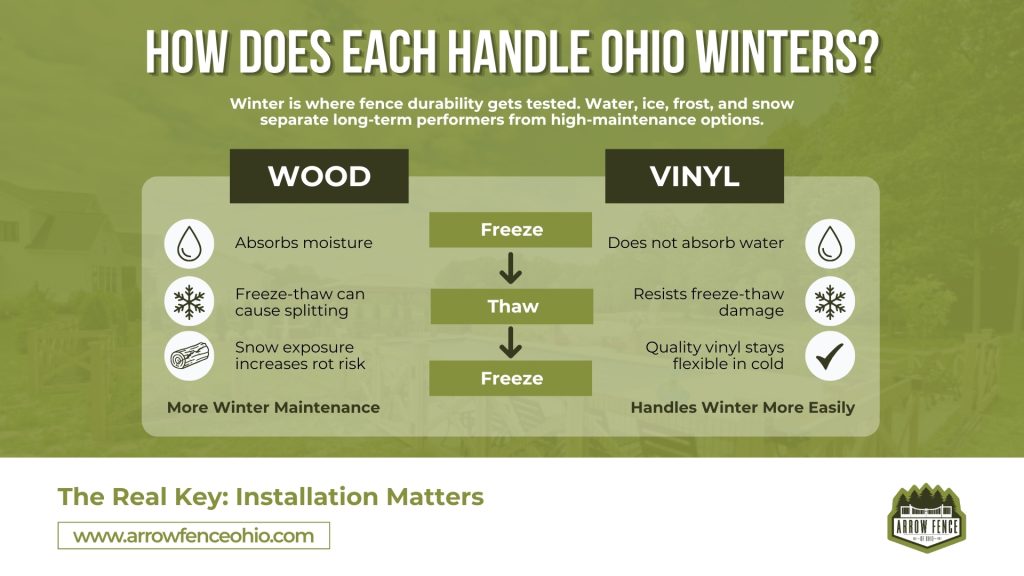
Vinyl handles Ohio winters with less drama, but quality and installation decide how both materials survive. Winter is where the freeze and thaw cycle does its worst, so this is the season that separates a fence that lasts from one that fails early.
Wood in winter takes on water during thaws, then that water freezes and expands. Repeat that dozens of times, and you get splitting, cupping, and popped fasteners. Snow piled against the boards keeps them wet longer, which speeds up rot at the bottom rail and posts. Good drainage, a quality stain, and proper post depth slow all of this down, but they do not stop it. Road salt is an underrated winter threat near driveways and sidewalks. Salt spray and salty snowmelt are hard on wood and on the metal fasteners holding it together, accelerating corrosion at exactly the joints you depend on.
Vinyl does not soak up water, so the freeze and thaw cycle has far less to grab onto. The one thing to know is that cheap, thin vinyl can get brittle in deep cold and crack on impact, like when a kid kicks a ball into it on a frozen January day. Thicker, quality vinyl from a real manufacturer is built to flex in the cold and avoid that. The takeaway: In our winters, vinyl needs less babysitting, but with either material, the install matters as much as the product. Posts set below the frost line and proper spacing keep the whole fence from heaving when the ground freezes. In our area, the frost line runs deep enough that a shallow post will lift over a single hard winter, which is the most common reason a fence starts leaning a year or two after a budget install.
Resale and Curb Appeal: Which Adds More Value?
Both materials boost curb appeal, and the better question is which look fits your home and how long you want it to stay sharp. A clean, well-built fence signals a cared-for property to buyers, so either choice helps when you sell.
Wood brings warmth and a classic, natural look that many Ohio buyers love, especially on older or traditional homes. The catch is that wood only adds value while it looks good. A faded, leaning, gray fence can actually hurt curb appeal, so its resale benefit depends on you keeping up the upkeep.
Vinyl holds its clean appearance for decades with almost no effort, which is a strong selling point. It stays bright white or whatever color you choose, with no peeling or graying. Some buyers feel vinyl looks less natural than real wood, so it partly comes down to taste and the style of the neighborhood. For long-term, low-effort curb appeal, vinyl usually wins. For that warm, traditional wood character, nothing else quite matches it, as long as you are willing to maintain the look.
Match the fence to the neighborhood, too. In a subdivision where every backyard runs white vinyl, a wood fence can read as out of step, and the reverse is true on a street of older homes with mature trees. Buyers tend to reward the choice that fits the block. Color holds value on vinyl in a way it never does on wood: a tan or gray vinyl panel looks the same at year fifteen as it did on install day, while wood demands a fresh coat to look its best for a showing.
How Do You Actually Choose Between Them?
Match the material to how long you will stay and how much upkeep you want to do. That is the whole decision in one line. Run yourself through a few quick questions:
- Staying 15 plus years and want minimal work? Vinyl is the stronger pick for lifespan and lower lifetime cost.
- Want the lowest upfront price or a natural look you will refinish? Wood fits, as long as you commit to the maintenance.
- Worried about the bigger vinyl bill today? Financing can spread it out so the longer-lasting option stays within reach.
- Not sure which suits your yard, slope, or drainage? That is worth a conversation before you buy, since the install affects how long either one lasts.
There is no single right answer for every yard. The right answer is the one that fits your timeline, your budget, and your tolerance for weekend upkeep. If you want gates, pet containment, or a specific height, those details can tip the choice too. A heavy gate, for example, puts more strain on a post, which is one more spot where install quality decides whether the fence holds up. Slope is another tie breaker: stepped vinyl panels follow a grade cleanly, while a steep yard can force extra cutting and custom work on a wood run.
Ready to Pick the Fence That Fits Your Yard?
We have installed both materials across Ohio yards for years, and we are happy to walk your property, talk through wood vs vinyl honestly, and give you a real number for either one. When you want straight advice and a fence built to last our winters, reach out to Arrow Fence of Ohio, and we will help you choose with confidence.
