


 Call Mon–Fri 8:00 AM–6:30 PM · Sat 9:00 AM–2:00 PM





TL;DR
Chain link fence maintenance in Central Ohio works best in a fixed order: check posts for movement, check fabric for slack and ground clearance, check hardware for missing ties and loose bands, then treat bare steel before it pits. Columbus sets its standard frost depth at 32 inches, while the published industry minimum footing for a six-foot fence works out to 30, so post heave is the failure we find most often and the one homeowners suspect last. Zinc coating class decides how many winters the mesh survives, and damaged galvanizing gets repaired with zinc-rich paint under ASTM A780 rather than household spray enamel. Do the walk in late summer or early fall, ahead of the average first freeze around October 27.
What Does a Chain Link Fence Actually Need Every Year?
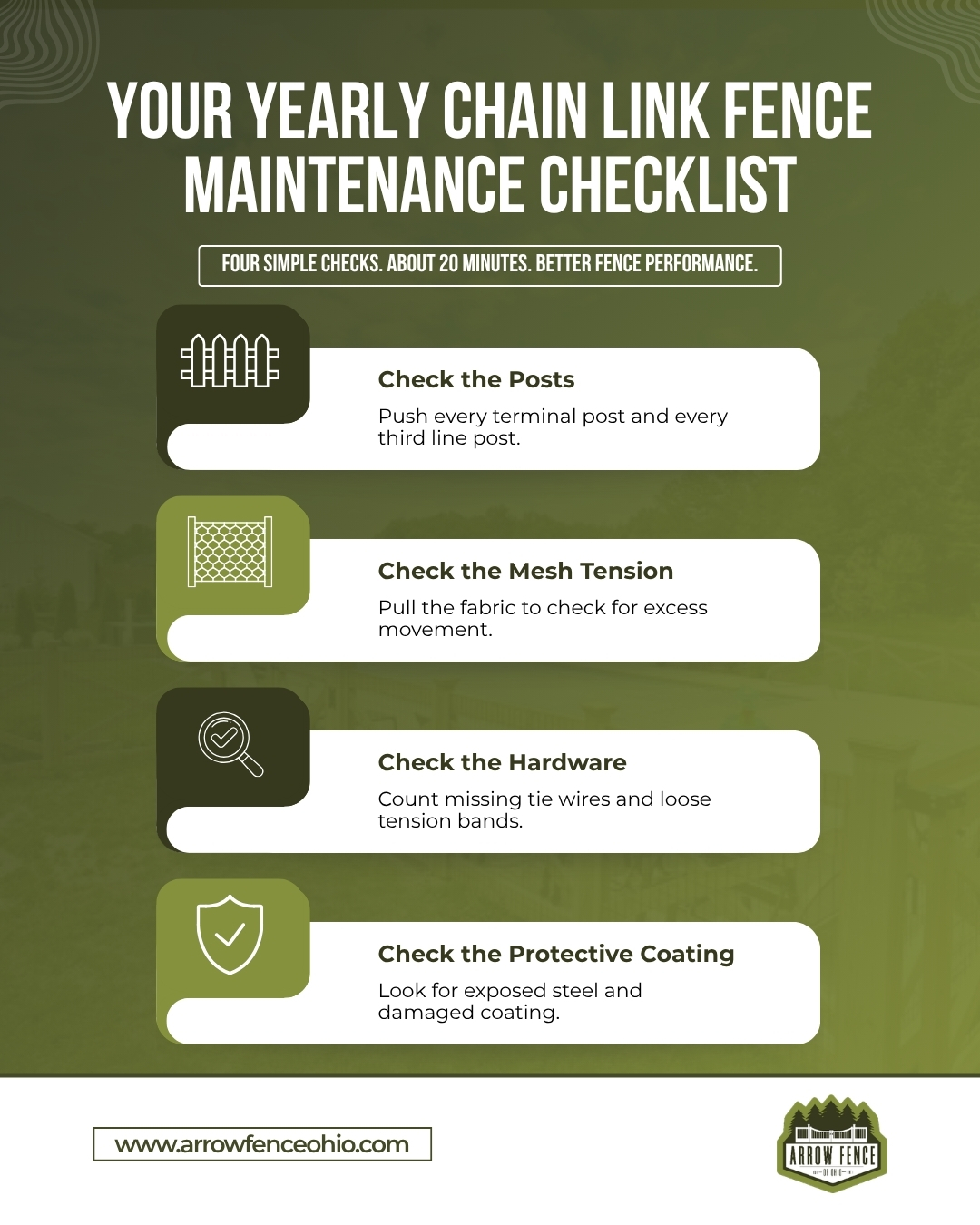
Four checks, and they take about twenty minutes on a residential run.
- Posts: push hard on every terminal post and every third-line post to find movement.
- Fabric: grab the mesh mid-span and pull, because more than an inch or two of give means it has lost tension.
- Hardware: walk the line, counting missing tie wires and loose tension bands.
- Coating: look for bare steel where the zinc has been scraped, cut, or worn through.
That is the whole annual program. Everything else people put on these lists- the hosing down, the mildew scrubbing, the vine pulling- is cosmetic or seasonal, and none of it keeps a fence standing. A clean fence with a heaved corner post is still a failing fence.
Order matters here more than most homeowners expect. Retensioning fabric on a post that has already tipped locks the lean in place and puts the load on hardware that was never designed to carry it. Posts first, always.
Why Central Ohio Winters Attack the Footing First
Water expands as it freezes, and the soil around a fence post is full of it. Each freeze lifts the ground and anything gripped by it; each thaw drops the ground back down, but not always to the same place. Repeat that a few dozen times a winter and a post walks upward out of its hole. That is frost heave, and it is the single most common structural failure we see on Central Ohio chain link.
The freeze-thaw count under your posts
The number that makes this a local problem rather than a general one comes from NOAA. At the Columbus airport station, NOAA’s 1991 to 2020 U.S. Climate Normals put the average year at 97.7 days with a minimum temperature at or below 32 degrees, but only 27.1 days when the temperature never climbs back above freezing. Subtract one from the other, and you are left with about seventy days a year when the ground around your posts freezes overnight and thaws again by afternoon.
Columbus does not get one long deep freeze that locks the soil and leaves it alone until March. Columbus gets seventy cycles, and it is the cycling that does the damage. A fence in northern Minnesota can sit frozen solid for months and move less than one in Gahanna.
Franklin County soils make it worse. Much of the metro sits on clay-heavy glacial till that drains slowly, so the soil next to a post stays saturated going into each freeze. Saturated soil heaves harder than dry soil. Any spot where downspout runoff, a driveway edge, or a low corner of the yard dumps water along the fence line is where we expect to find the first leaning post.
The footing depth gap nobody explains
Here is the part that surprises people. Columbus City Code Section 4125.03 sets the standard frost depth for construction in the city at 32 inches.
The installation practice the fence trade works from sets a shallower floor. ASTM F567 puts the minimum footing at 24 inches plus another 3 inches for every foot of fence height above four feet, and the Chain Link Fence Manufacturers Institute restates those same numbers in its freely published product specification.
Run the arithmetic on a standard six-foot fence, and you get 30 inches.
Two inches shallower than the depth Columbus considers frost-vulnerable. The same specification says as much in plain language, noting that soil conditions, local frost depth, fence height, and wind load may all require deeper or wider footings than the minimum.
So a fence built exactly to the trade minimum is legal, sold as correct, and still sitting inside the frost zone in Franklin County. That is not a scandal; it is a floor being mistaken for a target. It also explains why so many ten-year-old fences around Westerville and Reynoldsburg have one or two posts standing visibly proud of the rest.
What you can do about an existing fence is narrower than what we can do at install.
Keep water away from the base. Regrade so the soil slopes away rather than pooling, move a downspout discharge, clear the gravel or mulch dam that has built up against a post over the years. The same specification calls for the top of a post footing to be crowned so it sheds water away from the post, and on older fences that crown has usually eroded flat or gone slightly concave, which turns each footing into a small basin.
A post that has already lifted does not settle back on its own. It needs pulling, the hole needs deepening past 32 inches, and it needs resetting in fresh concrete. We walk through resetting a leaning fence post in more detail elsewhere, including how to tell heave from rot.
Reading the Fabric: Slack, Ground Clearance and Missing Ties
Chain link fabric is a tensioned component. Installers stretch it between terminal posts, then hold it to the line posts and rails, and it performs only while that tension holds. Slack mesh is not a cosmetic complaint. Slack mesh transfers load into the ties and bands, which then fail one at a time.
The installation specification gives you numbers to check against, which is more than any homeowner guide will hand you:
| What to check | Published maximum | What a failure looks like |
| Tie wires securing fabric to line posts | 12 inches on center | Wide gaps, fabric bellying out between ties |
| Ties securing fabric to top rail | 18 inches on center | Mesh dropping away from the rail mid-span |
| Hog rings securing fabric to tension wire | 18 inches apart | Bottom edge lifting, pets and rabbits under it |
| Fabric ground clearance | No more than 2 inches | A gap you can slide a boot through |
| Tension wire position | 4 inches up from the bottom of the fabric | Wire sagging on the soil, rusting fast |
Count your ties.
Seriously, count them. Where the original installer went to 12 inches, and half the ties have since broken or unwound, you are effectively at 24, and the fabric will belly. Replacing tie wires is genuinely a homeowner job: the specification calls for aluminum alloy ties wrapped around the post and twisted two full turns onto the fabric picket on each side, or preformed galvanized steel ties wrapped a full 360 degrees and twisted three turns.
Ground clearance deserves its own look. That two-inch maximum exists so animals cannot push under and so the bottom edge stays out of standing water and lawn chemicals. On sloped yards around Powell and Upper Arlington, erosion under the fence line opens that gap gradually enough that nobody notices until a dog does.
One more thing worth knowing on taller fences. End, corner, pull, and gate posts are supposed to be braced and trussed on any fence six feet or higher, and on five-foot fences with no top rail. If your six-footer has bare terminal posts with no horizontal brace and no diagonal truss rod, the corners will pull in over time no matter how carefully you maintain everything else.
Rust Is a Coating Problem Before It Is a Paint Problem
Galvanized chain link does not rust because it got wet. It rusts where the zinc is gone, and only there. Understand that, and the whole rust question changes shape, because the answer stops being “which spray paint” and starts being “how much zinc was on it and where has that zinc been removed?”
ASTM A392, the standard governing zinc-coated steel chain link fabric, defines two coating classes: Class 1 at 1.2 ounces of zinc per square foot, and Class 2 at 2.0 ounces. Class 2 carries roughly two-thirds more zinc on the same wire and is available in the heavier 9 and 6 gauge fabrics.
Residential fencing is very often Class 1. State highway work is not, because ODOT’s material specification for chain link fence calls for the heavier class of coating on Type I zinc-coated fabric. The state buys the thicker zinc because the state is paying for the next thirty winters, and road salt spray is part of the deal.
Salt shortens all of this.
It matters most near Central Ohio arterials and on any driveway that gets treated.
Chloride does not wear the zinc off mechanically so much as it speeds the electrochemical work the zinc is doing, and the coating gets used up faster.
Where the zinc has actually been breached, there is a real standard for the repair. ASTM A780 covers repairing damaged and uncoated areas of hot-dip galvanized coatings, and it names three acceptable materials: zinc-based solders, zinc-rich paint, and sprayed zinc. Notice what is not on that list.
Ordinary hardware store rust paint. A rust-inhibiting enamel puts a barrier over the steel and does nothing to restore the sacrificial zinc layer that was protecting it electrically, so the barrier fails at the first scratch and the rust then runs underneath the coating you just applied, spreading out of sight until the wire is pitted through.
So: wire-brush the spot back to sound metal, then use a zinc-rich product. Cut ends get the same treatment, and they are where we find the worst pitting on older fences. Every cut a previous installer or repair made exposed bare steel, and most of them were never touched afterward.
How Long Should a Chain Link Fence Last Here?
Longer than the footings that hold it, in most cases. Coating class sets the ceiling on the mesh, and the difference between 1.2 and 2.0 ounces of zinc per square foot is the difference between two service lives on otherwise identical fences. What tends to end a Central Ohio chain link fence early is never the mesh, though. It is a heaved terminal post that pulled the run out of tension, followed by years of the fabric working itself loose.
On residential galvanized fabric across our service area, we generally see two to three decades of useful life before mesh replacement enters the conversation, and posts needing attention well before that. Treat that as our field observation rather than a published figure, because no standards body publishes a service life for this product.
Vines, Brush and the Ohio Rule That Applies Outside City Limits
Pulling honeysuckle and wild grape off a fence looks like housekeeping. Out on rural property in Ohio, it is closer to a legal duty. Ohio Revised Code 971.33 requires an owner of land adjacent to a partition fence to keep all brush, briers, thistles, or other noxious weeds cut in the fence corners and in a strip four feet wide on that owner’s side of the line.
Read the chapter’s scope before you apply it to your own yard. Section 971.03 of the same chapter states it does not apply to the enclosure of lots inside municipal corporations. If you are on a city lot in Columbus, Dublin, or Worthington, the partition fence law is not your rule.
If your fence runs a line in a Delaware County or Licking County township, it very likely is. Section 971.06 puts the obligation to keep an existing partition fence in good repair on both adjoining owners in equitable shares, and that is a conversation with a neighbor worth having before a section fails, not after.
Owners running a line fence on acreage should also read the maintenance schedule differently from a suburban homeowner, which is part of why we treat farm and rail fencing as its own service rather than a variation on residential work.
City lots have their own version of the vegetation rule, aimed at sightlines instead of weeds. Section 3321.05 of the Columbus City Code requires corner-lot owners to keep obstructions under two and a half feet high inside the clear vision triangles measured 30 feet along each intersecting street. Bare chain link passes that test easily because you can see straight through it. A chain link fence with five seasons of grapevine woven into it does not, and neither does one with privacy slats added at a corner.
Vines are also a structural load nobody accounts for. Grape and bittersweet add real weight and real wind sail to a fabric that was tensioned for neither, and the tendrils work into the zinc and hold moisture against it year-round. Cut them at the root in fall and pull them off after they have dried and gone brittle. Wet green vine ripped off a fence takes coating with it.
A Maintenance Rhythm Built Around Ohio Frost Dates
Timing is the easiest thing on this page to get right, because the dates are published. The National Weather Service office in Wilmington puts the average first fall freeze at Columbus at October 27 and the average last spring freeze at April 18, both on 1991 to 2020 normals. Everything structural should happen outside those two dates.
| When | What | Why then |
| Late August to early October | Post-check, re-tension fabric, reset anything moving, replace ties | Ground is workable, and concrete can cure well ahead of the October 27 average first freeze |
| Late October | Cut vines at the root, clear leaf and mulch buildup off the base of every post | Removes the wet material that holds moisture against steel all winter |
| Mid winter | Look only. Note posts standing higher than their neighbors after a hard thaw | Heave is most visible right after a thaw, and frozen ground cannot be worked anyway |
| Late April onward | Zinc repair on bare spots, hardware replacement, gate adjustment | Past the April 18 average last freeze, so coatings cure and resets stay put |
Right now, in August, you are in the best window of the year for the structural work. Concrete poured in the next several weeks has two full months to cure before Columbus typically sees its first freeze, and the ground across Franklin and Delaware counties is dry enough to dig without fighting saturated clay.
Gates get their own note in every season. A swing gate is specified to hang with about three inches of bottom clearance and no more than three inches of offset at the hinge and latch, and those tolerances go out of range the moment a gate post shifts. If yours has stopped closing cleanly, work out whether the frame or the post moved before you buy hardware; we cover how to diagnose a gate that has stopped latching step by step.
Repair, Retension or Replace: Where We Draw the Line
Most of what is on this page is homeowner work, and we would rather say so than pretend otherwise.
Tie wires, vine removal, drainage fixes, zinc touch-up on scraped spots, tightening bands: all of it is a Saturday with hand tools.
Two jobs are not.
Both involve stored energy or a hole in the ground. Retensioning a full run means pulling fabric with a stretcher bar and a come-along against terminal posts that must be sound enough to take the pull, and getting it wrong bends a top rail or tears the fabric at the tension bar. Resetting a heaved post means digging past 32 inches through Franklin County clay, plumbing the post, and pouring a footing that actually sheds water. Both are the point where the honest answer stops being do-it-yourself.
Replacement comes in when the fabric has pitted through in multiple spots, when more than a few posts have moved, or when the original footings were shallow enough that every winter creates a new problem.
At that point, maintenance is buying single seasons at a rising price.
A fresh install lets us set footings for the frost depth this city actually has, and if a full run is on the table, our chain link fence installation Columbus page covers heights, gauges, coating options, and gate configurations. Budget is often the real constraint rather than the decision itself, so it is worth reading how fence financing works before you rule out doing the whole line at once.
Two other paths come up often enough to mention. Homeowners who want more screening from an existing chain link sometimes add slats, and sometimes find that what they actually wanted was a solid privacy fence. Others reach the replacement decision and use it to switch materials entirely, in which case how wood, vinyl, and aluminum compare in Ohio weather is the better starting point.
Walking Your Fence Line Before the First Freeze
Take twenty minutes this month and walk the whole line with a screwdriver and a notebook. Shove the screwdriver into the soil at the base of each terminal post to feel for softness, rock every post you pass, count broken ties, and mark any spot where water clearly collects. You will end up with a short list, and most of it you can handle yourself before October.
What is left over is the part worth a second opinion: posts that move, fabric that will not hold tension, and footings that were never deep enough for a Columbus winter. That is the work Arrow Fence of Ohio has been doing across Gahanna, Dublin, Westerville, and the rest of Central Ohio since 1991, and late summer is when our schedule still has room before the ground hardens.
