


 Call Mon–Fri 8:00 AM–6:30 PM · Sat 9:00 AM–2:00 PM





TL;DR
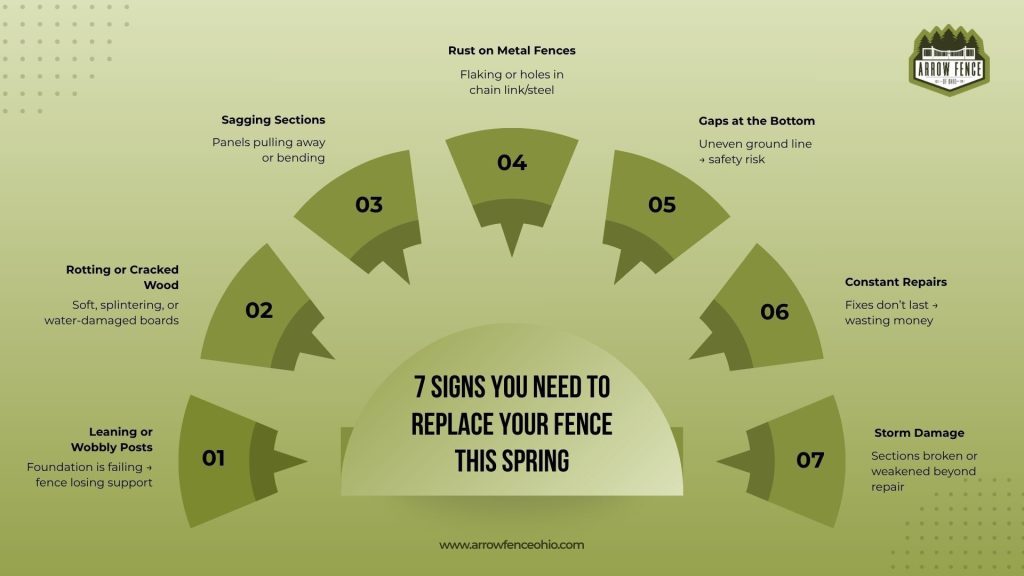
Replace your fence this spring if you see leaning posts, rotted boards, multiple loose panels, rust-eaten metal, large gaps along the bottom, repeated repairs that don’t hold, or sagging sections that pull away from the rails. Each of these is usually a sign of structural failure that won’t get better with patching alone.
Ohio winters can be brutal on fences. Heavy, wet snow, freezing winds, icy rails, soggy ground around posts, animals leaning on panels, and fallen branches all take a toll. By the time spring arrives, many fences look like they’ve been through a war. Some can recover with minor repairs, but others are past the point of saving, and delaying fence installation only increases costs when something finally breaks.
If you’re wondering whether it’s time for fence installation this spring, you’re not alone. Homeowners across central Ohio ask this every March and April. The truth is, fences rarely fail all at once. They give warning signs. Knowing what is repairable and when a full fence installation is necessary can save you time, money, and headaches before the fence collapses on its own.
Why Spring Is the Right Time to Make the Call
Spring is the best time to evaluate a fence for one simple reason. The damage from winter is fully visible, the ground is workable for new posts, and you’ve got the whole growing season ahead to enjoy a fresh installation. Wait until summer, and you’re looking at higher demand, longer wait times, and possibly fighting heat and dry soil during installation. Wait until fall, and you might miss your window before the ground freezes again.
Spring also gives you the chance to handle fence problems before they become safety issues. A leaning fence in March might stand. The same fence in July, after a thunderstorm with 40 mph winds, often doesn’t. We get a lot of emergency calls in summer for fences that should have been replaced two months earlier.
Sign 1: Posts That Lean or Wobble
The posts are the bones of your fence. If they go, the whole thing goes. Walk along your fence and grab each post firmly. A healthy post doesn’t move. A failing post will wiggle, lean, or sink slightly into the ground. You can also check by sighting down the line. A straight fence runs in a clean visual line. A fence with bad posts will show waves and dips.
The most common cause of post failure in Ohio is rot at ground level. Wood posts buried in soil hold moisture against the wood for years, and the part of the post inside the ground rots first. By the time you see surface damage, the underground portion may be almost gone. Once that happens, no amount of patching brings the post back. It needs to come out, and a new one needs to go in.
Concrete-set posts last longer, but they’re not immortal. Frost heave in Ohio winters can crack the concrete and shift the post over time, especially on smaller diameter posts that weren’t set deep enough.
Sign 2: Wood That Crumbles, Splits, or Soaks
Press your thumb into a fence board near the bottom. If the wood gives easily, you’ve got rot. If the surface is dry and you can pick splinters off with your fingernail, the wood has lost its integrity. Healthy fence wood feels firm and resists pressure.
Other red flags on wood fences include:
- Black or green discoloration at the base of boards
- Visible mushrooms or fungi growing from the wood
- Boards that hold water hours after the rain stops
- Cracks running the full length of a board
- Fasteners that pull out of the wood with very little effort
Patching one or two bad boards is fine. Patching half the fence is throwing money away. At a certain point, a full replacement is cheaper than buying piece after piece.
Sign 3: Sagging or Pulling Sections
Stand at one end of your fence line and look down it. Are there sections that bow outward or inward? Panels that pull away from the rails? Boards that lean on each other instead of standing straight? Sagging usually means the structural support behind the panels is failing. Either the rails are rotting, the fasteners are giving way, or the posts can no longer hold the weight.
Once a section sags, the strain on the rest of the fence grows. The neighboring posts take on an extra load. The fasteners on the next section start working loose. Sagging spreads.
Sign 4: Rust on Chain Link or Metal Fences
Chain link fences are tougher than wood in some ways, but they have their own end of life. Rust on the wire mesh is the giveaway. Light surface rust is cosmetic and not a problem. Deep rust that flakes off in your hand or eats holes in the mesh is structural failure. Rusted top rails bend and bow easily. Rusted posts snap during storms. Rusted gate hardware quits working.
If you’re seeing rust everywhere on a chain link fence that’s more than 15 or 20 years old, replacement is usually a smarter move than patching. New galvanized or vinyl-coated steel will hold up much longer than trying to repair rusted-out hardware piece by piece.
Sign 5: Big Gaps Along the Bottom
A new fence has a uniform line along the ground. As fences age, gaps develop. Sometimes from soil erosion, sometimes from boards rotting away at the bottom, sometimes from animals digging underneath, sometimes from frost heave lifting parts of the fence and not others.
Big gaps cause two problems. First, they let pets and small kids slip through. Second, they’re a sign that the fence has lost its proper relationship with the ground. Once the bottom edge is uneven and broken, the rest of the fence is rarely far behind.
Sign 6: Repeated Repairs That Don’t Hold
This one is more about your patience than the fence itself. If you’ve replaced the same gate latch three times, fixed the same panel twice, reset the same post last fall and the year before that, and patched boards every spring for the last few years, the fence is telling you something. It’s at the end of its useful life. Each repair is buying you a few months at most.
We see this all the time. A homeowner spends $300 in repairs every year for four years and ends up paying $1,200 for a fence that still doesn’t look right. The same money would have started toward a real replacement.
Sign 7: Storm Damage You Can’t Reset
Ohio gets serious storms. Spring thunderstorms, summer microbursts, and the occasional tornado warning. Wind damage is one of the most common reasons fences come down. Sometimes a single hard gust knocks over a section that was already weak, and what looks like one panel down turns out to be a whole row of failing posts.
If a recent storm took out part of your fence and the rest is the same age, the rest is probably running on borrowed time. We can come out and assess what’s actually salvageable, but in a lot of cases, the smartest move is to replace the whole run rather than spot-patch a fence that will fail next storm again.
What Fixing Costs vs Replacing Costs
Here’s the math that catches homeowners off guard. Spot repairs feel cheap individually. A few boards here, a post reset there, a new gate latch. None of those bills hurt by themselves. But add them up over 3 to 5 years on old fence services in Ohio, and you’ve spent more than a new install would have cost. And the new install would have lasted 15 to 25 more years.
A simple way to decide: if the cost of repairs over the next 12 months would exceed 50 percent of a full replacement, replace it. Anything beyond that is throwing good money after bad.
What to Expect From a Real Replacement
Replacing a residential fence in Ohio usually takes 1 to 3 days for a typical backyard. The steps go like this:
- We come out, measure, and walk the line with you to discuss style and material.
- You get a written estimate.
- We file for any required permits and check for utilities before digging.
- The old fence comes down and gets hauled away.
- New posts go in, set in concrete, and given time to cure.
- Rails, panels, and gates get installed.
- A final walkthrough catches anything that needs adjustment.
Materials matter. Pressure-treated pine is the most common in Ohio for budget builds. Cedar lasts longer and looks better, but costs more. Vinyl is low-maintenance and great for homeowners who don’t want to stain anything. Aluminum and steel work for ornamental and pool fencing. Each has trade-offs, and the right choice depends on your yard and your priorities.
Wrapping Up
A fence is something most homeowners don’t think about until it’s clearly failing. By then, the damage is usually more serious than it looks. Pay attention to those seven signs this spring, and if more than two or three of them describe your fence, it’s probably time to start thinking seriously about replacement instead of another round of patches.
When you’re ready to talk through the options, we’ll come out, walk the line with you, and give you a straight answer on whether your fence has another season left or whether it’s time to start fresh. At Arrow Fence Ohio, we’ve handled fences across central Ohio for years, and we’d rather tell you something can be repaired than sell you a job you don’t need. Give us a call when you’re ready, and we’ll take care of it.
