


 Call Mon-Fri: 8:00 AM to 5:00 PM





TL;DR
To prep your fence for an Ohio summer, walk the line and check posts for wobble, tighten loose hardware, replace rotted or split boards, trim back tree branches, clear vines and weeds along the base, reseal or stain wood surfaces, and double-check gate hinges. A few hours now prevent real damage later.
Ohio summers don’t mess around. One week it’s a warm 78 and breezy, the next it’s 92 with a thunderstorm rolling through that drops half an inch of rain in 20 minutes and tosses tree limbs across the yard. Your fence is one of the first things to take a hit when the weather gets dramatic, and the difference between a fence that survives the season and one that ends up in pieces usually comes down to a couple of hours of prep work in late spring. If you take the time to prepare your fence repair for the summer heat and storms Ohio homeowners deal with every year, you’ll save yourself the headache of emergency repairs in July or August.
We get a wave of calls every storm season for fences that didn’t make it. Most of those failures were preventable with basic maintenance done in May or early June. Here’s the rundown on what to check, what to fix, and what to do before the first big summer storm shows up.
Why Ohio Summers Are Brutal on Fences
Three things gang up on fences during Ohio summers. Heat, wind, and water. None of them is subtle.
Heat dries out wood and warps boards. By July, untreated wood loses moisture fast, and boards that were straight in spring start curling and pulling away from the rails. Heat also softens any patch jobs you did with caulk or filler, and it expands metal hardware so screws loosen and brackets shift.
Wind is the bigger killer. Ohio gets straight-line winds that can hit 60 to 70 mph during summer thunderstorms. Microbursts are even worse. A fence that has any structural weakness, even a single bad post, becomes a target. Wind catches the flat surface of the panels like a sail, and once one section goes down, it pulls the next one with it.
Water is the slow burn. Heavy summer rain saturates the soil around your posts. Posts that were stable in spring start to tip when the dirt around them turns to mud. Add some wind to that wet ground, and the posts pull right out.
Walk the Whole Fence and Note Problems
Before you fix anything, you need to know what you’re working with. Grab a notebook or your phone and walk the entire perimeter of your fence in a quiet hour. Note every single issue you see, no matter how small. You’re looking for:
- Posts that wobble when pushed
- Boards that are loose, missing, or rotted
- Cracked rails
- Rusted or missing screws and brackets
- Gates that drag or won’t latch
- Vines, weeds, or shrubs growing into the fence
- Soil erosion at the base
- Tree branches are close enough to hit the fence in the wind
- Stain or paint that’s peeling, flaking, or worn through
- Any sagging sections
Don’t skip the back side or corners. Most homeowners never look at the side of the fence facing their neighbor, and that’s exactly where the worst damage tends to hide.
Tighten Hardware and Reset Loose Parts
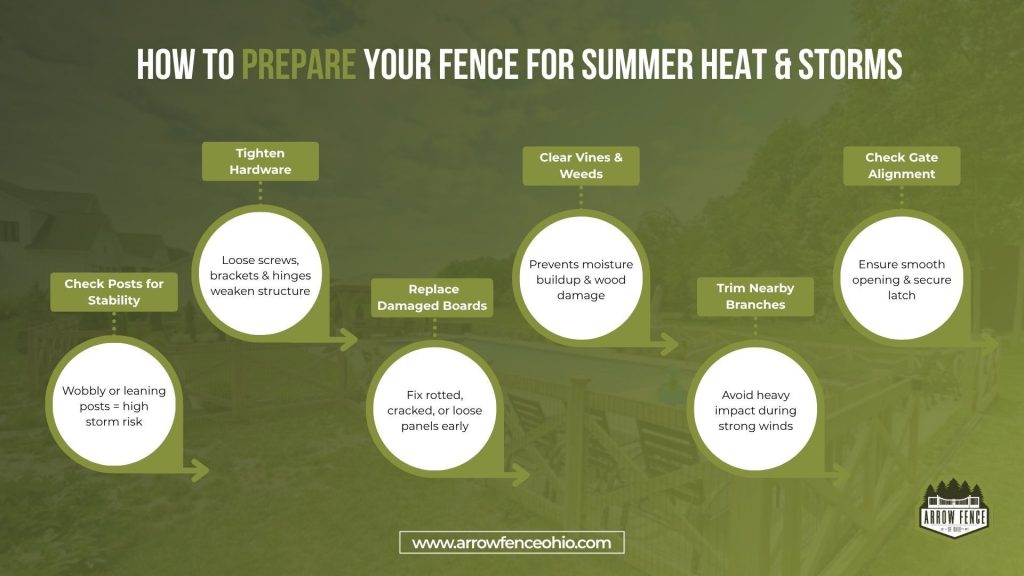
Most fence failures start with loose hardware that nobody notices. Screws back out over time, especially after winter freeze-thaw cycles. Brackets shift. Latches loosen. Take a cordless drill and walk the line again, this time tightening every visible screw on rails, brackets, and gates. If a screw won’t tighten because the wood underneath is soft, that board needs replacing.
While you’re at it, check the gate. Gates are the highest-stress part of any fence. They get used constantly, they hang on hinges that take all the weight, and they’re usually the first thing to fail. Make sure the gate swings freely, latches cleanly, and doesn’t sag when you open it. If the gate post wobbles, that’s a same-week fix, not a later-this-summer fix.
Replace Bad Boards Now, Not Later
Rotted or split boards aren’t just ugly. They weaken the whole fence around them. A fence section is only as strong as its weakest board, because rot spreads and the rails on either side lose their grip when wood softens.
Replacing a few boards is one of the easier DIY projects on a fence. Pry off the bad board, cut a new one to match, line it up, and screw or nail it in place. If you’re doing more than five boards in a section, though, the smarter move is usually to replace the whole panel and start fresh. Mismatched repairs look bad and don’t always hold under summer wind load.
Clear Vegetation From the Base and Sides
Vines look pretty climbing a fence. They also eat the fence alive. Vines hold moisture against wood, push between boards, force their way into joints, and add weight that pulls panels out of square. By summer, an unchecked vine can do serious damage in a few months. Pull them. Cut them at the root. Don’t just trim the visible parts.
The same goes for weeds and shrubs along the base. They trap moisture and dirt against the bottom rail, which speeds up rot and rust. Clear a strip about 6 to 12 inches wide along both sides of the fence so air can circulate and water can drain.
Trim Back Tree Branches
This is the single biggest thing you can do to prevent summer storm damage. Look up. Are there tree branches hanging over your fence? Are there branches close enough that a strong wind could swing them into the panels? Trim them back. Cut anything that could fall on the fence during a storm. Cut anything that touches the fence already.
We’ve seen entire fence runs taken out by a single branch falling during a thunderstorm. The branch was visible all spring. Nobody noticed it until it was lying across the yard with the fence underneath. Take the hour to trim. It pays for itself the first time a storm rolls through.
Reseal or Stain Wood Fences
Wood fences need protection from the sun and rain. Stain or sealant blocks UV rays and keeps water from soaking into the grain. Most quality stains last 2 to 4 years before they need a refresh. If your fence looks gray, dry, or faded, it’s overdue.
The order of operations for restaining:
- Pressure-wash the fence on a low setting to remove dirt and loose stain.
- Let the wood dry fully for 24 to 48 hours.
- Sand any rough spots or splinters.
- Tape off anything you don’t want stained, including plants and concrete.
- Apply stain with a brush, roller, or sprayer, working in the direction of the grain.
- Apply a second coat if the manufacturer recommends it.
- Let it cure for 24 to 48 hours before letting pets or kids near it.
Pick a stretch of dry weather. Don’t try to stain right before a storm. Don’t stain in direct hot sun, since the stain dries too fast and looks blotchy.
Check the Soil Around Your Posts
After a wet spring, the soil around fence posts can erode or shift. Walk the line one more time and look at the base of every post. Is the soil packed tight against the post? Is there a depression around the post where water has carved away the dirt? Is the post still standing straight?
If you see erosion, pack fresh topsoil around the post and tamp it down firmly. If a post is starting to lean, that’s a job for a fence pro before the first big summer storm. Resetting a single post is relatively cheap. Resetting six posts after a fence comes down is not.
Quick Maintenance Checklist for Summer
If you only have an hour, do these things in this order:
- Walk the line and note problems.
- Tighten every loose screw and bracket.
- Trim every tree branch within 5 feet of the fence.
- Pull vines and weeds from the base.
- Replace any obviously rotted boards.
- Test every gate and tighten its hinges.
- Reseal wood if it looks dry or faded.
That’s the bare minimum for getting through Ohio summer in one piece.
When to Call in a Pro
Some things really are best handled by someone with experience. Call a fence company if:
- Multiple posts wobble or lean
- A whole section is sagging or pulling away
- You can’t get a gate to align, no matter what you do
- You see structural rot in the rails, not just the boards
- Storm damage has already happened, and you’re not sure what to do
- You’re seeing the same problem over and over after DIY repairs
Better to bring in someone before something fails than to deal with the aftermath.
Wrapping Up
A fence isn’t going to take care of itself, especially in Ohio summers. Heat, wind, and storms will find every weak point. The good news is that most of those weak points are easy to spot and fix in a single Saturday if you know what to look for. Walk the line, tighten things up, trim what’s hanging over, and patch what needs patching. Then enjoy the rest of the season knowing you got ahead of it.
When something looks bigger than a weekend project, we’re happy to come out and take a look. At Arrow Fence Ohio, we handle everything from a single bad post to a full storm-damage rebuild, and we’ll always tell you straight what needs attention now versus what can wait. Give us a call when you’re ready, and we’ll get your fence ready for whatever the season throws at it.
