


 Call Mon-Fri: 8:00 AM to 5:00 PM





A new wood fence is ready for its first coat of stain as soon as the boards pass a simple water test, which for modern pressure-treated pine is usually within six weeks and for cedar should be sooner still. The old advice to wait six months or a full year comes from older wood treatments, and federal research shows that leaving bare boards in the sun that long can shorten the life of a solid stain or paint. In Columbus, the calendar sets the second limit: our normal overnight lows stay at 50F or warmer only from early May to early October.
TL;DR
When to stain a new fence in Central Ohio comes down to two tests. First, the wood: pressure-treated pine is ready once sprinkled water soaks in instead of beading, which the lumber maker YellaWood says is ideally within six weeks of construction, and the U.S. Forest Products Laboratory says one week of drying is generally enough for the surface of waterborne-treated wood. Cedar should be finished as soon as possible, because sunlight starts breaking down the surface within weeks.
Second, the weather: Columbus airport climate normals keep the average overnight low at or above 50F from May 9 to October 2, and September has the fewest wet days of any month. A fence built in late October usually waits for May. After the first coat, a semitransparent stain lasts longer each time it is reapplied.
How Long Should a New Wood Fence Wait Before the First Coat?
A new wood fence should wait only until the surface is dry enough to absorb stain. Pressure-treated pine often needs a few weeks, while cedar needs days, not months.
The test is the same for both: sprinkle a little water on a few boards. If it beads, wait and test again in a few days. If it soaks in, the fence is ready.
That water test comes straight from YellaWood’s own guidance on staining pressure treated wood. The same page says the old habit of waiting six months or a year no longer applies to newer micronized copper treatments, and that the ideal is to stain within six weeks of construction, provided the wood is dry.
Where the six-month rule came from
Treated lumber leaves the plant wet, because the preservative is forced into the wood with water. Waiting used to be the only way to let that water leave.
The U.S. Forest Service’s *Wood Handbook* explains what goes wrong when you do not wait at all. Wood treated with waterborne preservatives can be painted or stained once it is clean and dry, but the preservative can bleed through the finish if the wood is still wet, especially under latex paint and solid-color stain.
The handbook’s figure is that one week should be enough for the surface to dry for finishing. So the honest range runs from about a week to about six weeks, not half a year.
| Fence wood | First coat, per the sources | What to check first |
|---|---|---|
| Pressure-treated pine | Within about six weeks, once water soaks in (YellaWood) | Sprinkle test on several boards, including shaded ones |
| Waterborne-treated wood, any brand | About one week of surface drying (Forest Products Laboratory) | Surface dry to the touch, no bleed under a test patch |
| Cedar | As soon as possible after install (Forest Products Laboratory) | Surface clean and dry |
Why Waiting a Whole Season Can Backfire
Sunlight damages bare wood long before you can see it. The *Wood Handbook’s* chapter on finishing wood, written by Forest Products Laboratory research chemist Christopher Hunt and published in 2021, calls sun exposure before a film-forming finish a major cause of coating failures.
The research behind that is specific. Western red cedar boards left facing south for 16 weeks before painting peeled and needed refinishing within 3 years. Boards exposed for just 1 week started peeling after 13 years, and boards that were never exposed were still in good condition after 20. Denser woods held up better: Douglas-fir and southern yellow pine showed little loss of adhesion until they had weathered for 3 to 4 weeks.
In a Columbus backyard, this changes the advice depending on the finish you want:
- Solid stain or paint on cedar: do not let the boards sit through a summer. Finish them as soon as they are dry.
- Solid stain or paint on treated pine: aim to finish inside the first month, once the sprinkle test passes.
- Semitransparent penetrating stain: a little weathering is less of a problem, because these stains soak in rather than forming a film that can peel. The handbook even calls them an excellent finish for weathered wood.
The handbook also gives a quick way to check an older fence you inherited with a house. Press a strong tape firmly onto the bare wood and snap it off. If wood fibers come away on the tape, the surface is sun-bleached, and a paint or solid stain will struggle to hold.
The Columbus Calendar Decides More Than the Lumber Does
The wood tells you whether the fence is ready. The weather tells you whether the day is.
The *Wood Handbook* sets a floor for latex, waterborne coatings: apply them when the temperature is at least 50F and expected to stay there for 24 hours, and avoid late afternoons when heavy dew is expected overnight. It also warns against coating hot surfaces in direct sun.
Many fence stains on the shelf are waterborne, and the label on your can may set its own limit. That label wins. The 50F line is still the right starting point for planning.
We checked that line against NOAA’s 1991 to 2020 climate normals for the Columbus airport station, the long-term record for John Glenn Columbus International Airport. The normal daily low first reaches 50F on May 9 and last sits at 50F on October 2. That is the practical growing season for Gahanna, Westerville, Reynoldsburg, and the rest of Franklin County, give or take a few days for low spots and river valleys.
| Month | Normal high | Normal low | Share of days with 0.10 inch of rain or more |
|---|---|---|---|
| May | 74.1F | 52.4F | 27.3% |
| June | 82.2F | 61.6F | 25.6% |
| July | 85.4F | 65.4F | 23.6% |
| August | 84.1F | 63.9F | 20.5% |
| September | 77.8F | 56.5F | 18.2% |
| October | 65.5F | 44.8F | 18.7% |
Source: NOAA NCEI 1991 to 2020 U.S. Climate Normals, station USW00014821, Columbus. The rain column averages NOAA’s daily probability of 0.10 inch or more across each month.
Why September is our favorite month for it
September is the month the numbers point to. Nights are still comfortably above 50F, afternoons are cooler than July, and it has the lowest share of wet days of the season on the same NOAA record. May has the most wet days, so a spring staining plan in Dublin or Powell should leave room for rained-out weekends.
July brings its own trouble. Normal highs above 85F mean a board in full sun gets hot, and the handbook’s warning about coating hot surfaces applies. Work the shaded side in the morning and the sunny side after it has cooled, or pick another week.
A fence finished in late October
Once the normal low drops under 50F in early October, a waterborne finish is working against the calendar. A fence we build in November is usually better left until the May window opens.
That wait is not wasted for a treated pine fence. It dries through the winter, and if you plan on a semitransparent stain, light weathering does little harm. Cedar that you want to paint or solid-stain is different, so talk to us before installation about finishing the boards early, since the handbook’s advice for cedar is to finish it as soon as possible after it goes up.
Which Finish Holds Up Longest on a Fence?
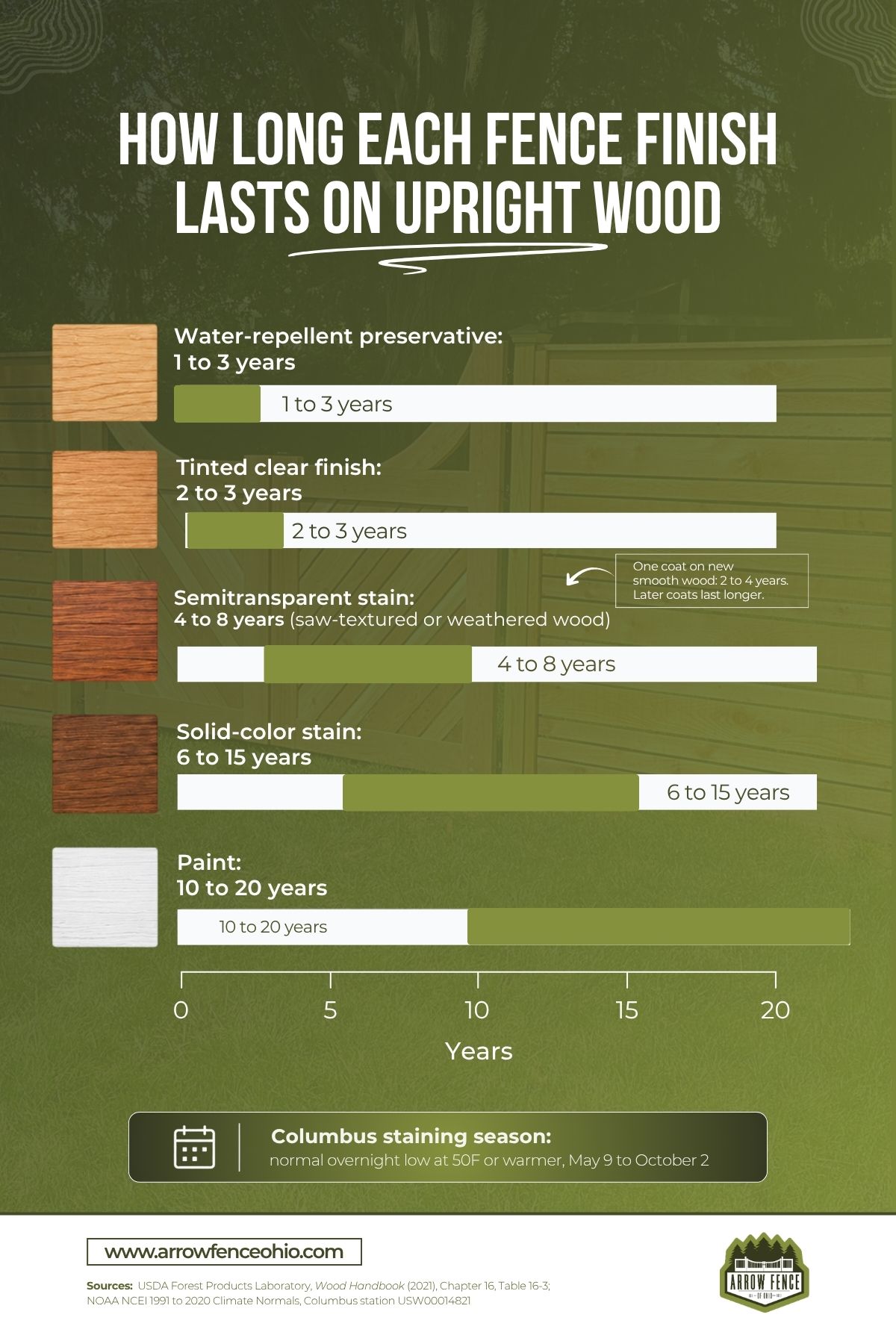
Fence boards stand upright, and the *Wood Handbook’s* Table 16-3 gives expected service life for wood in exactly that vertical exposure. The ranges are wide because the handbook says life depends on surface preparation, climate, exposure, the amount and quality of finish, and the wood itself.
| Finish | How it looks | Expected service life (Wood Handbook, Table 16-3) |
|---|---|---|
| Water-repellent preservative | Grain visible, fades to gray | 1 to 3 years |
| Tinted clear finish | Grain and color slightly changed | 2 to 3 years |
| Semitransparent stain | Grain visible, color as chosen | 4 to 8 years on saw-textured or weathered wood |
| Solid-color stain | Grain hidden | 6 to 15 years |
| Paint | Grain hidden | 10 to 20 years |
Longer is not automatically better on a fence. Paint and solid stain last longest, but when they fail they peel, and fixing them means scraping, sanding, and priming. Semitransparent stain wears away instead of peeling, so a recoat is mostly cleaning and brushing. That trade is why so many Central Ohio homeowners with cedar or board-on-board fences stay with a semitransparent stain.
Smooth boards versus rough-sawn
Texture matters more than most people expect. The handbook says semitransparent stain on smooth wood lasts roughly half as long as on saw-textured wood, because the rough surface holds more finish. Two coats on rough-sawn wood may last 10 years, while one coat on new smooth wood lasts only 2 to 4.
It also recommends brushing oil-based semitransparent stain rather than rolling or spraying it, staining two or three boards at a time while keeping a wet edge, and wiping off anything still shiny about an hour after a second coat. A shiny patch means stain sat on top instead of soaking in, and that thin film can crack and peel.
How Often Does a Stained Fence Need Another Coat?
A stained fence needs another coat when water stops beading on it, the color has faded toward gray, or mildew is darkening the boards. On semitransparent stain, the *Wood Handbook* puts the first coat on new smooth wood at 2 to 4 years. The good news is that each later coat tends to last longer, because weathered wood is more porous and takes in more stain.
So the first recoat usually comes around sooner than people plan for, and later ones stretch out. Walk the fence each spring and look for these signs:
- Sprinkle water on the sunniest run. If it soaks straight in, the water repellency is gone.
- Compare the south-facing side with the shaded side. A big color gap means the sunny side is due.
- Look for dark mildew near the bottom of boards and on north-facing runs.
- Check for film finishes lifting at board edges and around fasteners.
The spring walk pairs well with the other checks we cover in getting a fence ready for summer heat and storms, and the fall version is in our list of things to inspect before winter.
Getting an Old Fence Ready Without Tearing It Up
Preparation for a recoat is lighter than most people assume. With a semitransparent stain that is wearing normally, the handbook’s instruction is to use a dry, stiff-bristled brush to remove dirt, dust, and loose fibers, then restain.
Mildew is the exception. It has to come off first, with a commercial mildew cleaner or a dilute household bleach and detergent solution, rinsed well. YellaWood’s guidance also lists deck cleaner or soap and water with a brush, and asks for about 24 hours of drying before the stain goes on.
About pressure washers: both sources are cautious. YellaWood warns against using so much pressure that it damages the wood. The *Wood Handbook* lists aggressive power washing alongside sandblasting as a cause of the rough, washboard surface of eroded wood. If you use one, keep it gentle and moving, and let the brush do most of the work.
A short prep list:
- Brush every board, both faces if you are staining both.
- Treat mildew, rinse, and let the fence dry for about a day.
- Cover shrubs and flower beds. The handbook cautions that fungicides in semitransparent stains are toxic and can harm plants and the soil around them.
- Tape or tarp siding, patios, and anything else nearby.
- Check the forecast against the 50F and dew guidance above.
The rag rule nobody mentions
Rags, sponges, and paper towels soaked in oil-based stain can catch fire on their own. The *Wood Handbook* warns about this directly and says to put them in water and seal them in a water-filled, airtight metal container right after use. Do not leave them balled up in the garage or the trash can.
When Staining Stops Being a Weekend Job
A short run of new pine along a Hilliard patio is a fair weekend project. A few situations change that:
- A long privacy fence where both faces need coating, which doubles the work and means working from the neighbor’s side.
- A paint or solid stain that is peeling, which the handbook says calls for scraping, sanding, or stripping before recoating.
- Boards that fail the tape test, where any film finish will struggle to hold.
- A brand-new fence where the finish has to go on inside a short window before sun and weather get to the wood.
That last one is where timing gets tricky, and it is why we offer fence staining in Columbus both for fences we have just built and for older fences that have faded. On a new cedar or treated pine fence, it means the first coat can be planned from the day the posts go in instead of guessed at months later. Homeowners weighing that choice for a new wood privacy fence in New Albany, Worthington, or anywhere in Delaware County should raise it at the estimate.
Plan the First Coat Before the Fence Goes In
The best time to decide how a wood fence gets finished is before it is built. Pick the finish first, since solid stain and paint on cedar want to go on almost immediately, while semitransparent stain on treated pine can wait for the sprinkle test. Then look at the calendar. A May to early October install leaves room to finish the same season, and September gives Columbus its driest weeks for it.
If you are planning a new wood fence or bringing an older one back, talk to Arrow Fence of Ohio about the wood, the finish, and the timing together. We work out of Gahanna across Central Ohio, and a free written estimate is the easiest way to get the staining plan settled before the first post goes in.
