


 Call Mon–Fri 8:00 AM–6:30 PM · Sat 9:00 AM–2:00 PM





Ask for a wrought iron fence in Columbus today, and the fence that gets built is, in most cases, one of two modern products: ornamental steel with galvanized, coated tubular pickets, or ornamental aluminum made to the same profile. True wrought iron is a separate metal, and new hand-worked metalwork is now fabricated from mild steel instead. The name stayed with the look. Which metal sits behind the word decides what you pay, how the fence ages through an Ohio winter, and whether a historic review board will sign off on it.
TL;DR
The wrought iron vs aluminum fence question usually starts from a wrong assumption, because very little sold under that name is wrought iron. True wrought iron is almost pure iron worked by hand, and the National Park Service notes that mild steel is now used for new hand-worked metalwork. A new “iron” fence is normally ornamental steel, which under ASTM F2408 is hot-dip galvanized and coated, or ornamental aluminum, which has its own standard, ASTM F2957. Steel is the heavier metal and sits higher per foot on our price sheet, while aluminum resists corrosion better and suits front yards and pools. In Dublin’s Historic District and in German Village in Columbus, the material also goes in front of a review board, so get the metal named on the quote before you sign.
What Is Wrought Iron, and Why Is It Rarely the Metal in a New Fence?
Wrought iron is almost pure iron, with less than 1% carbon, shaped by forging, bending, and drawing instead of being poured into a mold. It is rarely the metal in a new fence because the trade moved to steel. The National Park Service’s Preservation Brief 27 says plainly that mild steel is now used to fabricate new hand-worked metalwork and to repair old wrought iron elements.
That brief sorts the iron family by carbon content, and the sorting explains most of what follows.
| Metal | Carbon content | How it behaves |
|---|---|---|
| Wrought iron | Under 1%, usually 0.02% to 0.03%, with 1% to 4% slag | Soft, malleable and tough. Worked by forging, bending and drawing |
| Mild steel | Not more than 2% | Strong and easily worked. Less corrosion resistant than wrought iron or cast iron |
| Cast iron | At least 1.7%, usually 3.0% to 3.7% | Hard and brittle. Poured into molds. More corrosion resistant than wrought iron or steel |
Source: National Park Service, Preservation Brief 27, The Maintenance and Repair of Architectural Cast Iron.
Read the middle row twice. The metal that replaced wrought iron rusts more readily than the metal it replaced. That one fact is why every decent steel fence made today depends on what is wrapped around the steel.
Telling old ironwork from a modern panel
The Park Service gives a field test anyone can use from the sidewalk. Wrought iron pieces are simpler in form and less uniform, show signs of rolling or hand working, and are riveted or forge-welded together. Cast iron pieces are very uniform, repeat over and over, often carry mold lines, and are bolted or screwed together.
A modern ornamental panel is neither. Its pickets are usually tubes, every one identical, set into rails at a fixed spacing. If the fence along an older Columbus street shows rivets and slightly uneven bars, it may well be original. If every picket is a hollow twin of the next, it is most likely a manufactured steel or aluminum system, whatever the listing called it.
“Rod iron” and the other names for one request
People looking for this fence call it wrought iron, rod iron, ornamental iron, or simply a metal fence, and they nearly always mean the same picture: dark, open, vertical pickets with a rail top and bottom. Even the standards body treats the names loosely. The summary of the aluminum fence standard lists “aluminum wrought iron fence”, “ornamental metal fence” and “tubular picket fence” as names for the same product family.
So the word tells an estimator which look you want. It tells nobody which metal you are buying.
Two Standards, Two Metals: Reading “Ornamental” on a Quote
ASTM International publishes one specification for each modern metal, and the steel one draws the line in its opening paragraphs. ASTM F2408 sets minimum requirements for coated tubular picket ornamental fence systems made from galvanized steel components. Its scope then says the requirements do not apply to vertical bar fence systems using solid bar or wrought iron materials.
The published summary of that standard reads like a list of what separates a good steel fence from a poor one:
- The steel is galvanized by the hot-dip process, either before or after forming.
- A powder coating goes over it, in polyester or an epoxy and polyester combination, or a two-coat wet paint system is used.
- Fittings, fasteners, and decorative accessories have to meet the same protective coating performance as the panels and posts.
- The system is load tested four ways, and the coating is tested for adhesion, corrosion resistance, impact resistance, and weathering resistance.
Hot-dip galvanizing, as the American Galvanizers Association describes it, means dipping fabricated steel into molten zinc so the iron in the steel reacts with the zinc and forms a tightly bonded alloy coating. The powder coat is the color you see. The zinc is the layer underneath that still protects the steel after a mower or a snow shovel chips the color.
The lighter metal has its own document, ASTM F2957, which sets minimum requirements for architecturally coated, tubular picket ornamental aluminum fence systems. It covers materials, structural testing, dimensions, workmanship, finish testing, and certification. Grades vary inside the metal too. Nobility Fence, the manufacturer behind the Nobility line we distribute, sells a residential grade built on 5/8 inch pickets and a premium grade built on 3/4 inch pickets, which it describes as a slightly stronger panel.
A quote that says only “ornamental” or “iron style” has left out the part that matters most.
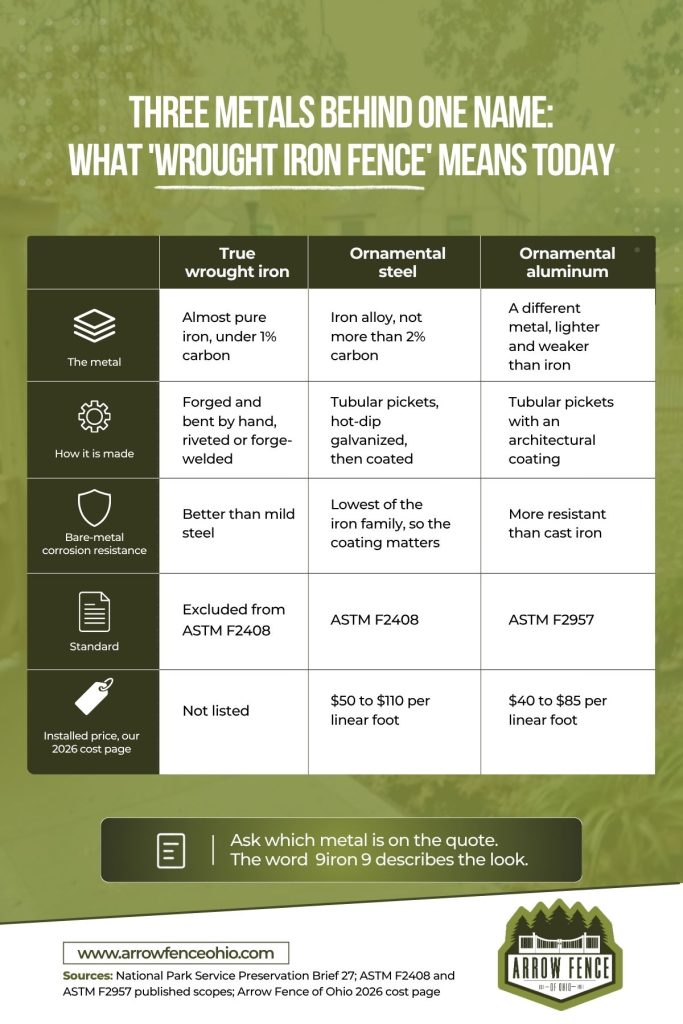
Wrought Iron vs Aluminum Fence vs Steel, Side by Side
Here are the three metals in one place, with the source for each cell named in the notes under the table.
| True wrought iron | Ornamental steel | Ornamental aluminum | |
|---|---|---|---|
| What the metal is | Almost pure iron, under 1% carbon, with 1% to 4% slag | An iron alloy with not more than 2% carbon | A different metal: lighter and less brittle than cast iron, and weaker than iron |
| How it becomes a fence | Forged, bent, and drawn by hand. Pieces riveted or forge-welded | Tubular pickets, hot-dip galvanized, then powder coated or two-coat painted | Tubular pickets with an architectural coating |
| Corrosion resistance of the bare metal | Better than mild steel, below cast iron | The lowest of the iron family, which the galvanizing and coating are there to cover | More resistant to corrosion than cast iron |
| Standard that covers it | Excluded from ASTM F2408 by that standard’s own scope | ASTM F2408 | ASTM F2957 |
| Installed price on our 2026 cost page | Not listed | $50 to $110 per linear foot | $40 to $85 per linear foot |
| Where you meet it | Surviving older ironwork. New hand-worked pieces are now made in mild steel | New ornamental fences in the heavier of the two modern metals | Front yards, pool fencing and decorative perimeters |
Notes: metal properties and corrosion ranking from National Park Service Preservation Brief 27. Fabrication and standards from the published scopes and summaries of ASTM F2408 and ASTM F2957. Prices and typical uses from our own cost page.
Two things stand out. The price gap between steel and aluminum is real, but the ranges overlap, so the metal alone does not settle the budget; our 2026 Ohio fence cost breakdown shows how length, gates, and design move the total. And true wrought iron has no row on our price sheet at all.
How Does Each Metal Hold Up Through an Ohio Winter?
Bare steel is the most rust-prone of the three metals and bare aluminum the least, so through a Central Ohio winter the coating does the real work on both. The Park Service brief explains the mechanism while writing about cast iron: rusting happens when iron is exposed to moisture and air; it needs a relative humidity of about 65%, and that threshold drops when corrosive agents such as salt air and acid precipitation are present. The same brief rates mild steel as less corrosion-resistant than cast iron.
It also says where rust starts. Rusting speeds up wherever a detail forms a pocket or crevice that traps liquid, and once a rust film forms, its porous surface holds more water against the metal.
On a fence, that means the trouble spots are predictable:
- Post bases, where snow piles and meltwater sits.
- The joint where a picket passes through the bottom rail.
- Brackets and fasteners, which the steel standard holds to the same coating performance as the panels.
- Any chip that goes through the color coat.
Most of that list passes aluminum by, with two cautions from the same source. A failed factory finish on aluminum is hard to replace well, because a durable field-applied coating is difficult to achieve once the original finish has gone. And aluminum is the weaker metal. Our own cost page is blunt about it: aluminum bends on a hard impact, and lighter pickets can dent under a falling branch.
Gates deserve a separate look on either metal. They carry moving weight on a few welds, and a weld that weakens over time is a known way for a steel or aluminum gate to fail.
The repair that mixes metals
This is the mistake we would most like owners of older Columbus homes to avoid. Galvanic corrosion happens when two dissimilar metals touch in the presence of an electrolyte, and the Park Service’s own example of an electrolyte is water containing salts. Its brief warns that aluminum placed in contact with or near cast iron may cause galvanic corrosion and should be avoided.
Picture a new aluminum gate bolted to an original iron post beside a salted front walk. Every thaw puts salty water into that joint. The fix is simple to describe and easy to skip: keep the two metals from touching, or keep the repair in one metal.
Where a Local Rule Picks the Metal for You
In a few Central Ohio districts the choice is partly made before you call anyone, and Dublin has put the most in writing.
Dublin’s Historic Design Guidelines note that wrought iron and stone fences are prevalent in the district. Where a new fence is proposed, they prefer traditional types: low stone walls, low picket fences, iron fences, and board fences for backyards. They call concrete, “cyclone” fencing and composite wood fencing not appropriate.
The city’s Historic District code goes further. Section 153.173 prohibits chain-link and vinyl fences outside of construction security, and holds fences to four feet in height and no more than 50% opaque unless the Architectural Review Board approves otherwise. Neither document names aluminum as a fence material, so whether an aluminum panel satisfies a guideline that says “iron fences” is the board’s decision. Bring the manufacturer’s product sheet to that conversation.
Outside the Historic District, the paperwork still applies, and according to Dublin’s administrative permits page, it starts before any post is set. A Certificate of Zoning Plan Approval is required before a fence goes in; the residential fence application costs $150, material specifications are part of the submittal, and review takes roughly five to seven business days.
That page carries a line worth acting on in October. Approvals stay valid for one year, and the city says fall and winter applications are very welcome and may shorten processing time.
Columbus handles its historic neighborhoods through commissions. The German Village Society’s historic preservation FAQ says a Certificate of Appropriateness is needed for exterior changes in the German Village Historic District, including any project that changes what the exterior of the property looks like. Most applications must include information about the materials to be used, and the commission hears cases on the first Wednesday of each month.
| Place | What the published rule says | What it means for an iron-look fence |
|---|---|---|
| Dublin Historic District | Iron fences named among preferred traditional types. Chain link and vinyl prohibited. Four feet and 50% opaque unless the board approves otherwise | An open metal picket matches the stated preference. The board still reviews the actual material |
| Dublin, citywide | Certificate of Zoning Plan Approval before any fence, with material specifications | Have the product sheet ready when you apply |
| German Village, Columbus | Certificate of Appropriateness for exterior changes, with materials information | Name the metal in the application, not just the style |
Westerville, Hilliard, Powell, and the other suburbs each write their own fence rules, and a homeowners association can be stricter than the city. We have not tried to reproduce every one here. Our installation guide covers what we handle on permits and timelines, including pulling the permit and working through your community’s rules.
Matching the Metal to the Job
Most decisions come down to where the fence stands and what might hit it.
- A front yard, a pool, or a decorative boundary where you want to see through the fence: this is aluminum’s home ground. Designated styles in the Nobility line come in a pool code-compliant version.
- A sloped lot: aluminum panels can be racked to follow the grade instead of stepping down it.
- A run where impact or weight matters more than upkeep: steel is the heavier metal, and its galvanized layer is doing the long-term work.
- Original ironwork on an older property: treat it as a repair question first. The Park Service advises bringing in a preservation architect or conservator for all but the simplest repairs, and looking at every means of repair before turning to substitute materials.
Security is the one place neither modern metal should be oversold. A decorative picket fence marks a line and slows a walker. It is climbable.
Aluminum is the ornamental metal on our service list today, and our page on aluminum fence installation in Columbus is where that work is described. We have made the naming point before, too: our own page on ornamental fencing says decorative fencing is often called wrought iron when it is most often coated steel or aluminum.
Questions to Put to an Estimator Before You Sign
Ask these of any fence company, ours included. None needs a technical background, and the answers should come without hesitation.
- Which metal is this panel, steel or aluminum?
- If it is steel, is it hot-dip galvanized, and what coating goes over the zinc?
- Is the system made to ASTM F2408 or ASTM F2957?
- What picket size and grade am I being quoted?
- Do the brackets, fasteners, and gate hardware carry the same finish as the panels?
- On a repair or an addition, what metal are the existing posts, and how will the new work be kept from touching them?
- Who files the permit or the review board application, and which material sheet goes in with it?
- Who stands behind the finish, the manufacturer or the installer, and can I have that in writing?
If the first answer is “it’s wrought iron”, ask to see the product sheet. Expect to find one of the two ASTM numbers on it.
Bring a Fence Photo and Your Address to the Estimate
The fastest way to get the fence you are picturing is to stop describing it by metal. Bring a photo of the fence you like and the address it is going to. The photo gives us the profile to match: picket spacing, height, the top detail. The address tells us which rulebook applies, whether that is a Dublin review board, a Columbus historic commission, or a subdivision covenant in Westerville, Hilliard, or Powell.
From there, the metal is a short conversation about budget, upkeep, and what the fence has to stand up to. Arrow Fence of Ohio works out of Gahanna, and we give free written estimates with evening and weekend appointments available. Ask us to write the metal, the grade, and the finish on the estimate.
